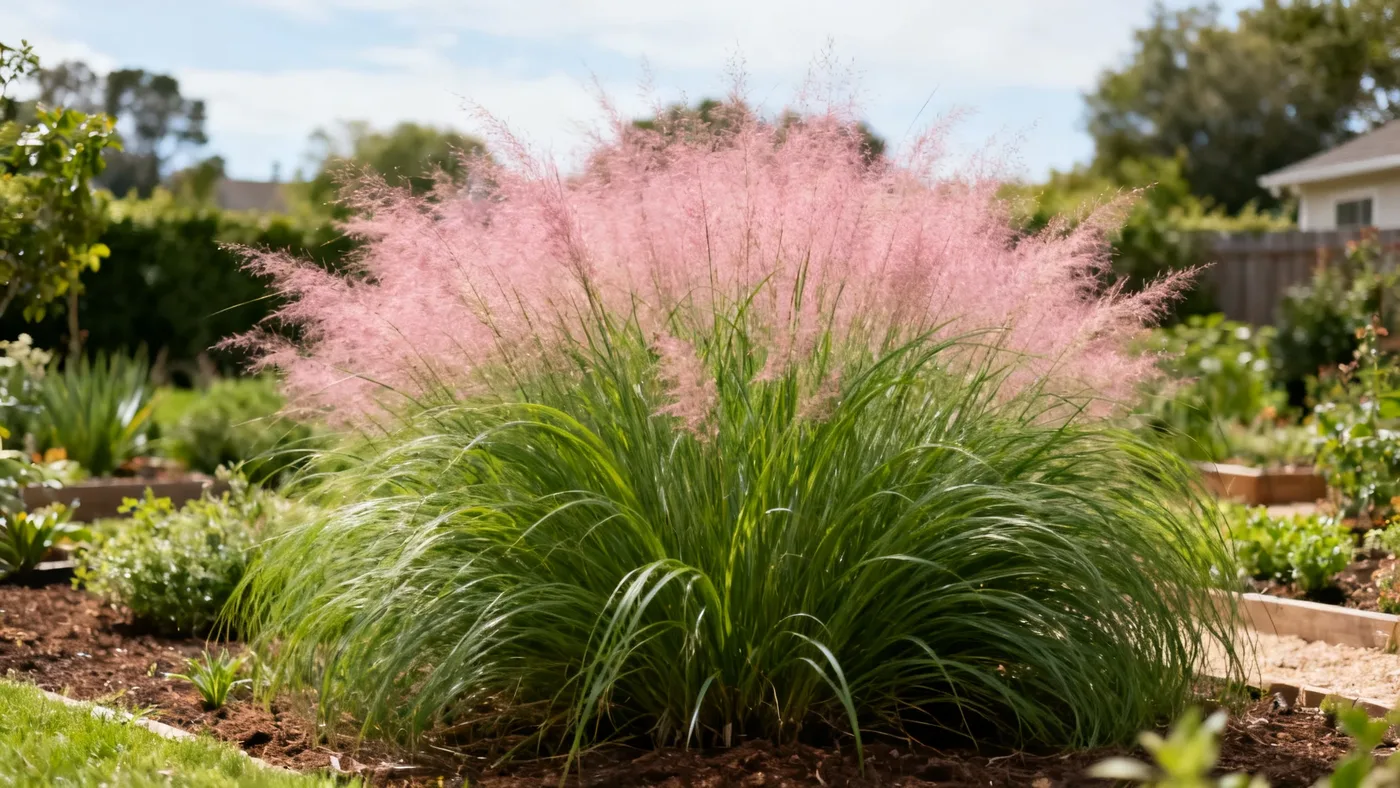
Pink Muhly Grass Varieties and Cultivars Compared
Pink Muhly Grass (Muhlenbergia capillaris) offers several cultivars and forms that vary in bloom color, timing, size, and hardiness. If you are planning a mass planting, a border accent, or a xeriscape feature, understanding which cultivar fits your space is the difference between a thriving display and disappointed expectations. This guide compares the main options available in the nursery trade: the standard pink form, 'White Cloud', 'Regal Mist', and 'Fast Forward', so you can select the right one for your garden.
Quick Comparison Table
| Cultivar | Bloom Color | Bloom Timing | Mature Height | Best For |
|---|---|---|---|---|
| Standard Pink | Airy pink to reddish-pink | September-November (varies by region) | 3-4 ft with plumes | Classic, reliable choice; mass plantings |
| 'White Cloud' | White blooms | September-November | 3-4 ft with plumes | Contrast, night gardens, cool palettes |
| 'Regal Mist' | Deeper pink, more saturated | September-November | 3-4 ft with plumes | Bold color impact, drama |
| 'Fast Forward' | Pink blooms | Earlier than standard, more compact | Slightly shorter than standard | Smaller spaces, earlier season interest |
The Standard Pink Form: Tried and True
The species Pink Muhly Grass produces airy pink to reddish-pink plumes that emerge in late summer and hold through fall, typically blooming from September through November depending on your region and latitude. This is the form most commonly stocked in nurseries and the baseline for all other cultivar selections.
The standard form reaches 2 to 3 feet in foliage height and 3 to 4 feet when the plumes are at full extension. Spacing is 18 to 36 inches apart, depending on whether you want a tight visual mass or looser, individual plants to breathe in a mixed perennial bed. Growth rate is moderate, roughly 6 to 12 inches per year, so you will see a noticeable clump by year two and mature size by year 2 to 3.
Pros: Reliable and widely available. Performance is well-documented across zones 6-9. The pink color is soft but visible from a distance, working well in informal plantings and meadow gardens. These plants establish quickly once watered in.
Cons: The pink tone is subtle; if you want a showy statement, this may feel underwhelming. In large drifts, the color can read as a soft haze rather than a focal point. Once established (usually year 2-3), the standard form does not require division or special maintenance, but that also means it will not compact if you wish a tighter habit.
Best for: Cottage gardens, coastal landscapes (salt tolerance is high), mass plantings where you want soft texture and subtle color rather than drama. Pairs well with black-eyed Susan, coneflower, and other late-season bloomers in zones 6-9.
White Cloud: The Cool-Palette Standout
'White Cloud' is a white-blooming cultivar that breaks the pink Muhly mold entirely. It produces the same airy plume texture as the standard, but in pure white. Bloom timing matches the standard form, arriving in September through November, and the mature height and width are identical: 3 to 4 feet with plumes, 2 to 3 feet in foliage.
Pros: White plumes offer dramatic contrast in mixed borders and are especially striking at dusk or under artificial light. They work beautifully in cool-tone gardens paired with silver foliage, purple coneflower, and ornamental sedges. The white form does not fade or become muddy as the season progresses; it holds its brightness through November. If your garden leans minimalist or monochromatic, 'White Cloud' is a showstopper.
Cons: Less readily available than the standard pink. Some nurseries carry it as a special order. The white blooms can look washed out in shaded locations. If your aesthetic is warm and rustic, white plumes may feel out of place in the garden scheme. Spacing needs are the same as the standard (18-36 inches), so it is not a space-saving option.
Best for: Night gardens and evening viewing, cool-color borders, contemporary and minimalist landscapes, containers where the white plumes are focal points, coastal gardens where salt tolerance is essential and bloom color contrasts with grayed foliage.
Regal Mist: Deep Pink Drama
'Regal Mist' is a selection with deeper, more saturated pink to purple-pink plumes. Where the standard form reads as soft and airy, 'Regal Mist' plumes are richer and more visible from a distance. Bloom timing and mature dimensions are the same as the standard: September-November blooming, 3 to 4 feet tall with plumes.
Pros: The deeper pink tone commands attention and works as a strong focal point. 'Regal Mist' does not disappear in a mixed border; the plumes hold their color saturation longer into fall and early winter. If you love the Muhly silhouette but want impact, this is the cultivar. Fall interest extends longer as the deeper tones fade to tan rather than washing out entirely.
Cons: Availability can be limited; not all regional nurseries stock this cultivar. The deeper color may clash with warm yellows or oranges in adjacent plantings. Like all Muhlenbergia capillaris selections, 'Regal Mist' reaches full mature size in 2 to 3 years and does not behave as a dwarf form, so space planning is critical in small gardens.
Best for: Bold late-season borders, contemporary gardens where you want a sophisticated color palette, xeriscape plantings as a focal specimen, mass plantings in larger landscapes where deep pink tones can anchor drifts of lighter companions. Pairs beautifully with grasses like little bluestem, which adds bronze fall color.
Fast Forward: Compact and Early
'Fast Forward' is a selection bred for earlier bloom and more compact growth habit. It reaches its peak bloom earlier than the standard form and maintains a slightly more restrained height, making it suitable for smaller spaces or containers where the full 3-4 foot height of other cultivars would overwhelm the planting. Bloom color is pink, similar to the standard form.
Pros: Earlier blooming means fall interest arrives sooner, sometimes by late August or early September depending on your zone. The compact habit means you can space these closer (still aiming for 18-36 inches, but the lower end works) without creating visual gaps. Excellent for containers, small borders, and transitional plantings. Growth rate remains moderate, so you still have a full-size clump by year 2-3, just in a tidier form.
Cons: The compact growth can mean thinner, less substantial plumes in some years if the plant is stressed. If you love the lush, cloud-like scale of standard Muhly, the more refined 'Fast Forward' may feel understated. Regional availability is sporadic; not all nurseries stock this newer selection. The earlier bloom window also means earlier seed set, so if wildlife benefits are a priority, this cultivar drops seeds before birds in your region may be ready.
Best for: Small gardens, raised beds, container growing, mixed borders where 3-4 foot height conflicts with sight lines, gardeners in cooler zones (6-7a) who want to guarantee blooming before frost, transitional spaces between low perennials and shrub forms.
Comparing to Related Species: Deergrass and Lindheimer's Muhly
Do not confuse Pink Muhly Grass cultivars with larger Muhlenbergia relatives. Muhlenbergia rigens (deergrass) grows 2 to 3 feet tall but is more drought-tolerant and suited to arid western gardens. Muhlenbergia lindheimeri (Lindheimer's muhly) reaches 3 to 4 feet and produces cream-white to reddish plumes. Both are excellent ornamental grasses, but they are different species with different care needs, hardiness ranges, and landscape roles. If you are shopping for Muhly species by size or color alone, confirm the botanical name to avoid surprises at planting time.
Selecting by Growing Conditions
All Pink Muhly Grass cultivars thrive in full sun to light or partial shade, though bloom color is most vibrant in full sun. In zones 6-9, all forms are reliably hardy once established. Soil must drain well; these grasses are adapted to sand, loam, or clay, but waterlogged soil invites root rot. Salt tolerance is high across all cultivars, making any of them a sensible choice for coastal gardens or landscapes near salted roads.
Once established, all cultivars are drought-tolerant. Establishment watering is regular during the first growing season, then you can reduce frequency. Light fertilizer in spring is optional; over-fertilizing causes floppy growth and reduces bloom, so restraint is wise.
For detailed season-by-season care, pruning schedules (cut back to 4-6 inches in late winter/early spring), and companion planting strategies, refer to the complete Pink Muhly Grass care guide for every season.
Which Cultivar for Your Situation
| Situation | Best Choice | Why |
|---|---|---|
| I want maximum visual impact. | 'Regal Mist' | Deeper pink is bold and visible from a distance. |
| I have a cool-tone or minimalist garden. | 'White Cloud' | White plumes work in silver and purple palettes; striking at night. |
| My space is small or I want containers. | 'Fast Forward' | More compact habit; earlier bloom for shorter growing seasons. |
| I want the classic, reliable choice. | Standard Pink | Widely available, well-tested in all zones 6-9, soft pink works everywhere. |
| I am mass-planting a large area. | Standard Pink or 'Regal Mist' | Both are sturdy, establish quickly, and offer the visual scale needed for drifts. |
| My budget is tight and availability matters. | Standard Pink | Most abundant; lowest price; quickest to source from regional nurseries. |