Pink Muhly Grass vs Purple Love Grass: What Sets Them Apart
One September afternoon we stopped beside a bank where two pink hazes stood side by side, and we would have sworn they were the same grass. Then we walked closer. One barely reached our shins, and the other stood a good deal taller and thicker, with plumes that hung on well past the first frost.
That gap decides everything in a planting. Choose the wrong one and you end up with a bed full of holes or a thicket you never planned for.
This guide covers everything you need to know about choosing between Pink Muhly Grass and purple love grass, from mature size and winter hardiness to self-seeding and the right site for each.
Two Pink Hazes, Two Very Different Sizes
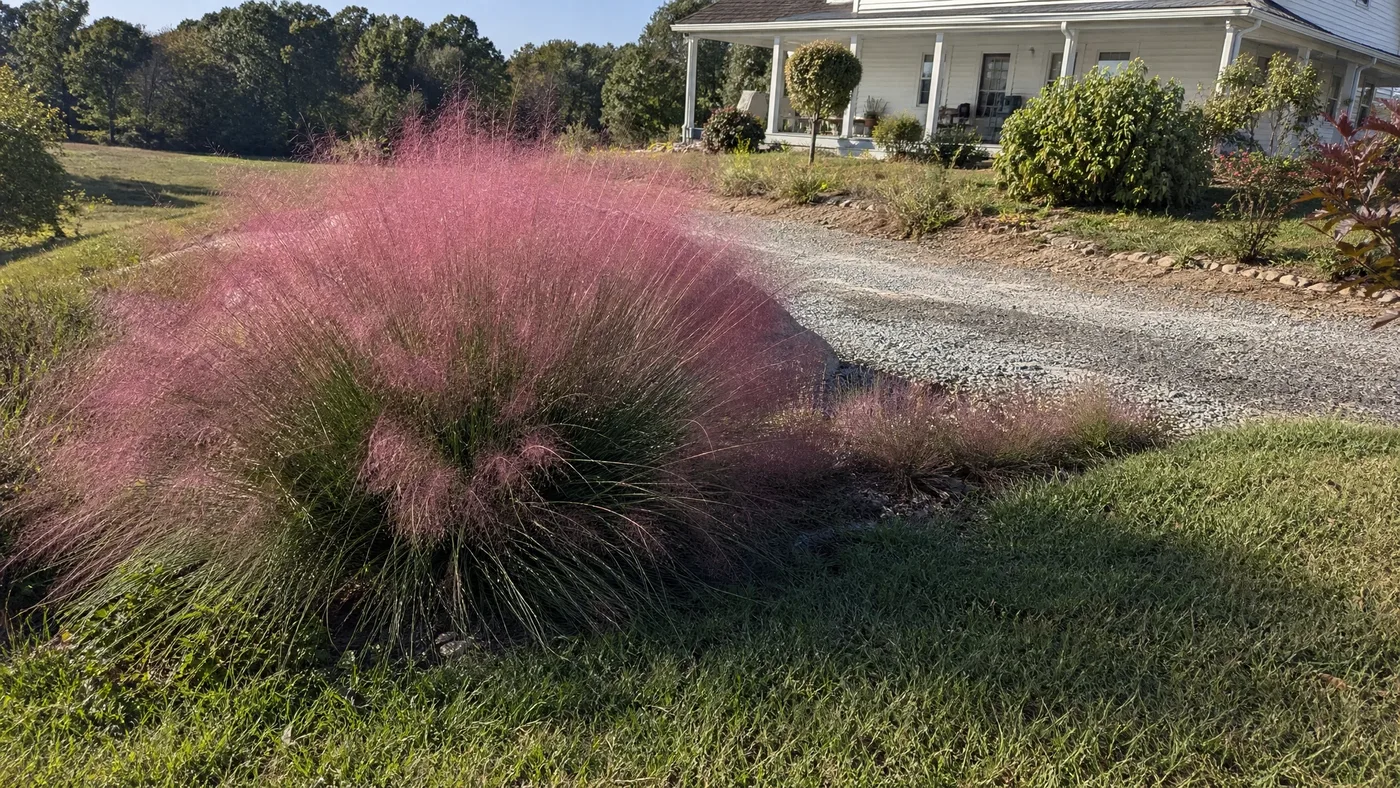
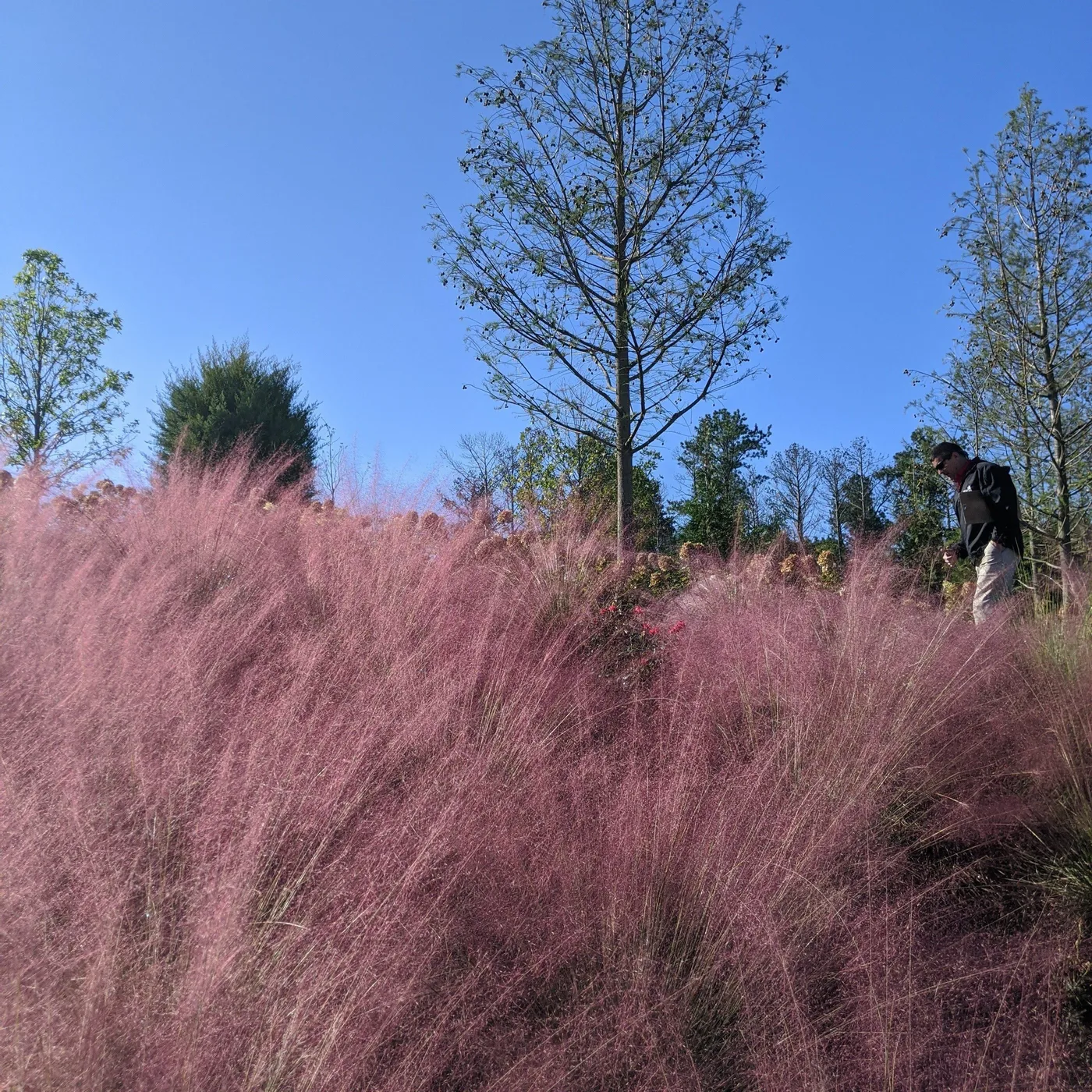
Pink Muhly Grass is the bigger plant by a wide margin. It measures 2 to 3 feet tall and 2 feet 4 inches to 3 feet wide, and it can reach 4 feet tall and 3 feet wide in good conditions. It forms a dense, rounded mound of fine leaves, and the pink plumes rise above it in a cloud from September through November.
Purple love grass (Eragrostis spectabilis) is a small plant by comparison. It grows 8 inches to 1 foot 2 inches tall, with a spread of 10 inches to 1 foot 4 inches. Its haze is low and airy, closer to a purple-pink mist drifting over the ground than a mass you could hide a mailbox behind.
| Trait | Pink Muhly Grass | Purple Love Grass |
|---|---|---|
| Height | 2–3 feet, up to 4 feet | 8 inches to 1 foot 2 inches |
| Width | 2 feet 4 inches to 3 feet | 10 inches to 1 foot 4 inches |
| Habit | Tight bunchgrass clump | Slowly spreading by rhizomes |
| Sun | Full sun, 6 or more hours | Check with your local extension service |
What the Size Gap Means in Use
A single Pink Muhly Grass can anchor a corner of a bed. Three of them make a wall of color at knee to hip height. You would need a dozen love grass plants to make the same visual weight, and they would never reach the same height.
If you want a plant you can see from the street, this is not a close call. For the full growth story, see our guide on how big Pink Muhly Grass gets.
Pink Muhly Grass Against the Look-Alike in Winter
The common claim is that purple love grass is the hardier plant and Pink Muhly Grass the tender one. The numbers are closer than that. NC State lists both for USDA zones 5a through 9b, and Penn State gives zones 5 through 9 for the muhly. Other sources put Pink Muhly Grass at 6 through 9 or even 6 through 11, so the cold edge of its range is where opinions split.
What we tell customers in zone 5 is to treat Pink Muhly Grass as worth trying, not guaranteed. Give it full sun and sharp drainage, because cold wet soil does more harm to a warm-season grass than cold air alone. Ask your local extension service how nearby plants have fared. Our hardiness zones guide goes deeper on this.
How Each Looks Once Cold Arrives
Both grasses are warm-season plants that go dormant, but they hold the winter landscape differently. Pink Muhly Grass carries a lot of volume: Mississippi State describes its pink flowers as cloud-like masses in fall and winter, and the plumes fade to tan rather than collapsing. Purple love grass is so low that it simply disappears under the first leaf litter or snow.
That makes the muhly the better choice where you want something to look at from the kitchen window in January. Cut it back in late winter before new growth starts.
Seedlings and Rhizomes in the Gravel Path
This is the contrast that surprises people most, because both grasses can fill a bare spot, but they do it differently. Gravel, lean soil and bare mulch are where grass seed lands and sprouts without competition, so a path edge is the place to watch.
Pink Muhly Grass is a bunchgrass. Illinois Extension notes that it doesn't spread from rhizomes, so the clump stays where you put it. It does set seed, and the University of Tennessee says it will naturalize by re-seeding, but the seedlings are easy to find and pull.
Purple love grass spreads slowly by rhizomes, and it also seeds. We tell customers that in lean, open soil it will wander farther than its size suggests, which is a feature in a meadow and a chore in a gravel garden.
Keeping Volunteers in Check
If you plant either one beside gravel, a few habits keep the surprises small:
- Cut the plumes before the seed ripens if you do not want volunteers, or leave them on and pull seedlings in spring while the roots are still shallow.
- Keep a mulch layer or dense planting around the clumps, since bare ground is what seedlings need.
- Set love grass where an edge, such as a paver or steel strip, marks where you want it to stop.
- Dig and divide muhly clumps rather than waiting for volunteers to fill in.
Our guide on how Pink Muhly Grass spreads and self-seeds covers the details.
Pink Muhly Grass for the Tidy Bed
In a controlled bed, you want plants that stay where you put them and look the same in year five as they did in year two. That is Pink Muhly Grass. It grows at a medium pace into a dense, rounded clump 2 to 3 feet across, it holds its shape, and it asks very little. Full sun, well-drained soil and room to breathe are most of the work.
It is also forgiving about soil. It accepts acid, neutral and alkaline pH, and the University of Florida notes it tolerates sand, loam and clay. Once established it handles drought, and it is highly resistant to deer grazing. That combination suits a front bed where you do not want to babysit anything.
Setting It Out
Plant in groups of three or five, or in a drift of ten or more along a drive. Space the clumps so their edges just touch at maturity, and the plumes read as one pink sheet. Our spacing guide has the numbers for borders and mass plantings.
Because love grass is so much smaller, it works as an edging or a front row in the same bed, but not as the main show. We grow Pink Muhly Grass ourselves in containers, so you can plant a full-sized clump on day one rather than waiting for a seedling to fill in.
For a tidy bed, the choice is Pink Muhly Grass.
Purple Love Grass for the Meadow Edge
A naturalized area asks the opposite of a bed. You want plants that knit together, fill gaps on their own and look at home beside wildflowers. Purple love grass fits that job. It spreads slowly by rhizomes and seeds in lean soil, so a small planting can thicken over the seasons without you doing anything.
It also keeps a low profile. At 8 inches to a little over a foot, it will not shade out the shorter wildflowers around it, and its haze sits below the stems rather than above them. On a sunny bank, a dry slope or a path edge where taller grasses would flop or block the view, that low airy habit is an advantage.
When Muhly Still Belongs There
Pink Muhly Grass is not out of place at a meadow edge. It tolerates drought, poor soil and salt, and it will reseed a little. Use it as the taller backbone at the back, with love grass in front where the planting meets lawn or path. Our landscape ideas guide lists companions that suit that layered look.
What changes is control. Love grass may not stay where you plant it. In a loose, naturalized area that is the point, and in a formal bed it is the problem.
What We Tell Customers About Pink Muhly Grass
One of the most common questions we get is whether the two are interchangeable, and the answer shapes everything else. Here is the advice we hear repeated and the advice we give instead.
Wrong: "They bloom the same, so just buy the cheaper one." The bloom looks alike from a distance, but the plant does not. A low 1-foot mist will not do the job of a 3-foot cloud, and the reverse is true too.
Right: Pick by the space, not the color. Measure the spot. If it needs height and mass, plant Pink Muhly Grass. If it needs a low carpet or a soft edge, plant love grass.
Wrong: "The one that's hardier is the safer choice everywhere." The zone ranges overlap far more than the label suggests. Choose by site conditions first, then check your local extension service about your coldest winters.
Right: Give either one sun and drainage. Pink Muhly Grass wants 6 or more hours of direct sun. Shade is the usual reason the plumes come in thin.
Wrong: "Grasses never need thought once they're in the ground." They need a little. Decide up front how much you want a plant to spread, because that is the one thing you cannot easily undo.
Living With Pink Muhly Grass Season After Season
Put the two side by side over several years and the pattern is clear. Pink Muhly Grass is the plant for a place where you want a clump, a color show and no surprises. Purple love grass is the plant for a place where you are happy to let things fill in. Match the grass to the spot before you buy, and both will be easy.
We still go out some October evenings when the low sun comes through the plumes and the whole row glows pink. That sight is the reason to choose the taller grass for the spot where you will see it most.
Pink Muhly Grass
Nursery-grown Pink Muhly Grass in sizes from 1 GALLON, shipped to your door.
From $78.94
Shop Now →Our Pink Muhly Grass gets bright sun and fast-draining ground on our farms, with no rich soil or feeding, which is why its clumps hold their shape and turn pink in fall. We are a small business that raises its own stock, top-quality grasses among it. If this comparison has you leaning toward one of the two, browse what is in stock now.