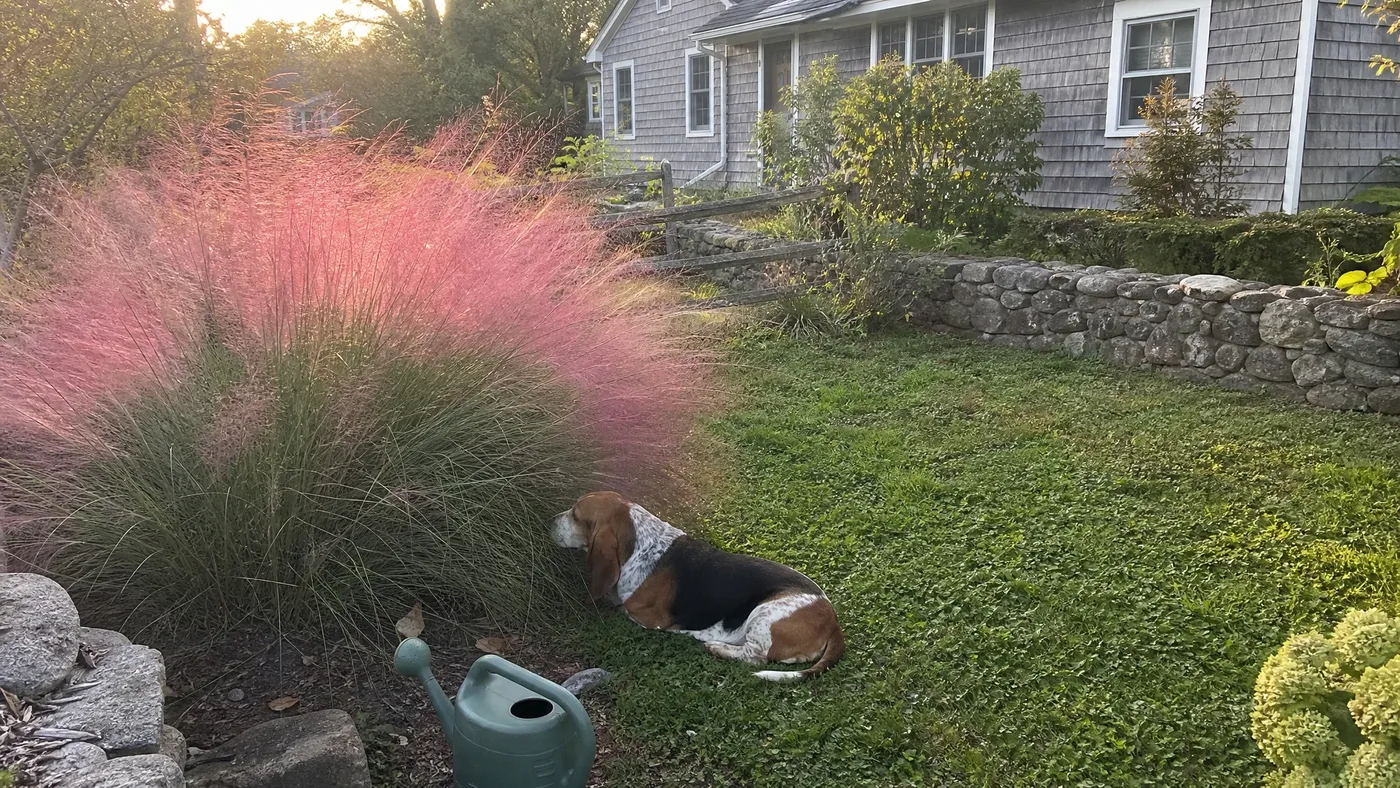
Is Pink Muhly Grass Safe for Dogs and Cats?
This season in our rows, customers kept asking about their dogs and cats rather than plume color. You have a pet, a plant in the cart, and one question to settle before you plant it.
Here is the answer up front. Pink muhly grass is a non-toxic ornamental grass. The risks are small and practical: a pet that gobbles blades can get a mildly upset stomach, as with any grass, and the fine plumes can catch in eyes, ears and paws in fall.
In this article, we'll go through how to check the toxicity question yourself, what to do about a chewing pet, how to judge stomach upset and plume irritation, and where to site the clump. We also cover when to call the vet. Our FAQ gives the one-line version, and this is the longer one.
Is Pink Muhly Grass Listed as Toxic?
No. Pink muhly grass is a non-toxic ornamental grass, and nothing in how it grows changes that. None of the extension sources we rely on flags any part of it as harmful, and UF/IFAS states plainly that there are no known pests or problems. We would not keep it out of a yard with dogs or cats.
We still like readers to confirm it themselves, because common names get shared between unrelated plants and a list entry for the wrong "muhly" tells you nothing.
Run the Check in Four Steps
This takes about five minutes and settles the question for your own pet.
- Write down the botanical name, Muhlenbergia capillaris, and the common name on the plant tag.
- Search a veterinary poison database for that name and for your pet's species, since a plant can be listed for one animal and not another.
- Note what else is in the bed. Companion plants, mulch and any fertilizer or spray are separate questions from the grass itself.
- If a list ever disagrees with what we say here, call your vet and go with their answer.
The choice at this stop: it is non-toxic, so it is fine to buy. Keep the other plants in your cart on the same checklist.
Pink Muhly Grass and a Chewing Pet
Dogs and cats chew grass. They do it on lawns, on ornamental clumps and on the weeds along a fence, and pink muhly is no different from the rest. Its leaves are thin and wiry, and the clump stands 2 to 3 feet tall for most of the year, which puts it right at nose height for a dog.
One of the most common questions we get is whether you have to stop the chewing. We say no.
Puppies and Young Plants
The bigger risk in the first season is to the plant. A newly planted clump has a small root system, and a puppy that chews and tugs can pull it half out of the ground. Give the plant a full season to anchor before you worry about the pet. A low fence or a few stakes around the clump for that first season is cheap insurance.
Keep the soil firm after planting and water as our watering guide describes, because a loose, dug-at clump dries out fast.
Cats and Blades
Cats usually take a few blades, and that is all. Pink muhly is a bunchgrass that stays in a tidy clump, so there is no running growth for a cat to shred. A few nibbled tips cost the plant nothing, and it keeps growing.
The choice here is to allow nibbling but not encourage it. Do not hand-feed it, do not plant it as a designated chew patch, and redirect a pet that treats it like dinner. Pets that eat any grass in quantity are the ones that get into trouble, which is the next stop.
When a Mild Stomach Upset Is Likely
Any grass can upset a stomach. A pet that eats a lot of blades quickly may vomit them back up, and that has nothing to do with this species being harmful. It is the volume and the speed, the same as with a lawn.
Pink muhly's fine, wiry blades come in dense clumps, so a determined animal can strip a surprising amount in one go. The reaction is usually brief.
What Mild Looks Like
A mild case is one or two bouts of vomiting, perhaps some drooling or a little extra grass in what comes up. The pet is still alert, still interested in food and water, and back to normal fairly quickly. If you see that, you have your answer: it ate too much grass.
What We Tell You to Do
Take the pet away from the clump and let the stomach settle. Offer fresh water in small amounts rather than a bowl gulped all at once. Hold off on a big meal until the pet seems comfortable, and ask your vet what they prefer for your animal's age and size.
The choice at this stop is to watch and offer water. If the pet repeats the behavior every time it goes outside, that is a sign to change where the grass sits (see the placement section) rather than a reason to pull out the plant.
Whether Awns Can Irritate Eyes and Paws
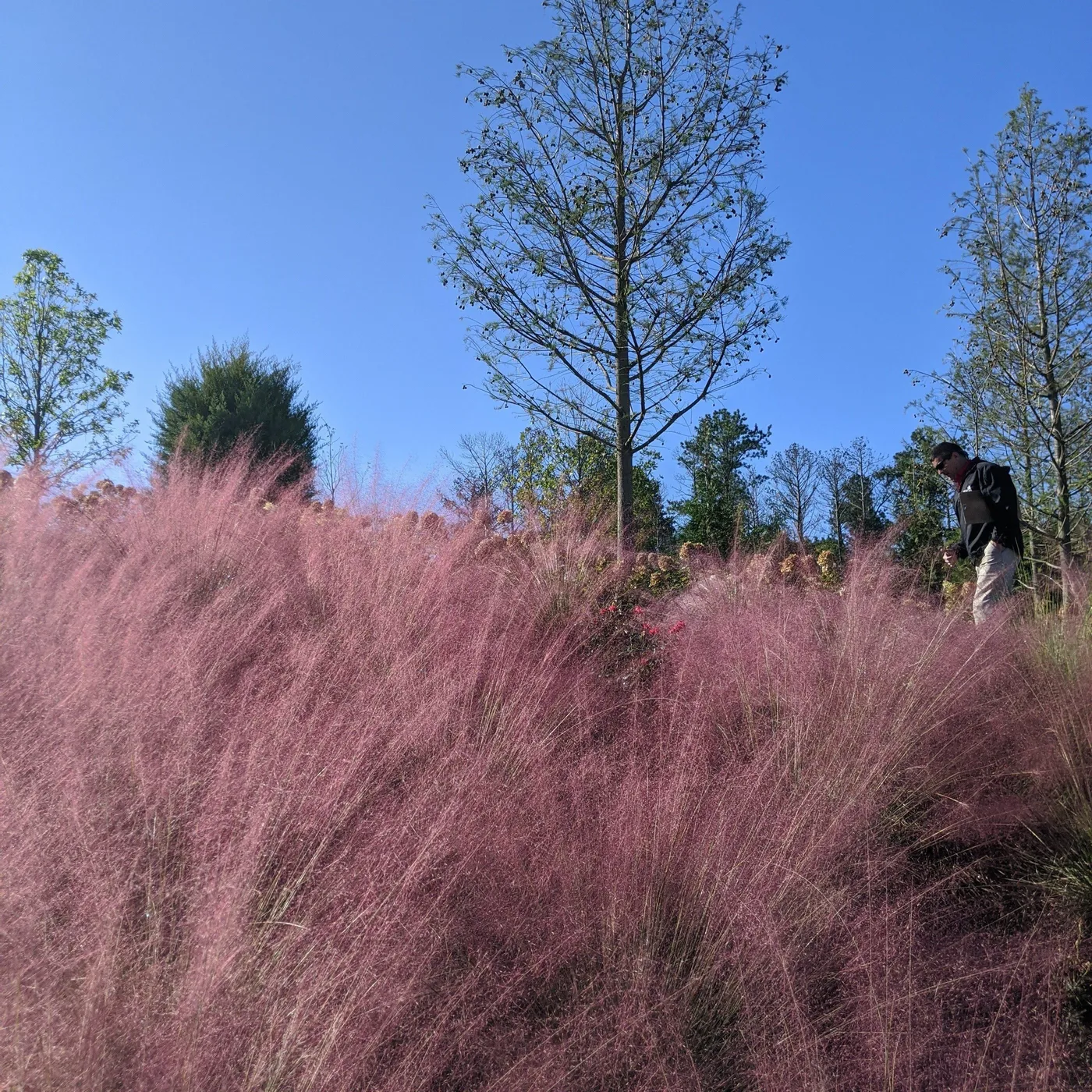
This is the real pet issue with pink muhly, and it is mechanical rather than toxic. The airy plumes run up to 12 inches long, open pink, purplish red or purplish gray, and dry to a light buff. Each plume carries tiny seeds with fine, hairlike awns, which is where the species gets the name hairy awn muhly.
The plumes start in early fall, and the pink season runs from about September into November. That is when a dog running through a planting comes out with seeds in its coat.
Most of the time the plumes just brush off. The trouble comes when a seed or a stiff bit of plume lodges somewhere it can't fall out: the corner of an eye, an ear canal, or between the toes. Long-coated and floppy-eared pets pick up the most.
A Ten-Minute Fall Check
After walks and yard time during bloom, we suggest this order:
- Eyes. Look for squinting, watering, redness, or a pet pawing at its face.
- Ears. Watch for head shaking or tilting, then look inside the flap.
- Paws. Spread the toes and look between the pads for seeds, then check for licking or limping.
- Coat. Comb out loose plume bits from the belly, legs and chest before they tangle.
The choice at this stop is to check eyes, ears and paws through fall. If you want the plumes out of reach altogether, the timing in our cutting-back guide shows when to take them off.
Placing Pink Muhly Grass Where Pets Roam
Siting does more for pet safety than anything else on this list. Pink muhly wants full sun, six or more hours a day, and well-drained soil, so it already belongs in the open, bright parts of the yard and not in the shady corner where a dog naps.
Where it lands decides how much of the plume your pet actually meets.
Good Spots
- Back a few feet from the main route a dog takes between the door and the yard, so plumes aren't brushing faces on every trip.
- In the middle or back of a border, with a lower plant in front. The spacing guide shows how much room a mature clump needs, up to roughly 3 feet across.
- In a large pot on the patio, if the pet has run of the lawn. Our container guide covers sizes and drainage.
Spots to Avoid
Skip the fence line where your dog patrols and digs. The seeds are eaten by songbirds and small mammals, so wildlife visitors will turn up there, and a pet that chases them will tear through the clump. Seedlings can also pop up where plumes drop, which is worth knowing if you have a digger, since this grass can naturalize by re-seeding.
The choice: sun, a few feet off the busiest path, and away from the fence-and-squirrel zone.
Signs That Mean a Call to the Vet
Most pet and pink muhly encounters end with a shake and a trot. A few signs deserve a phone call. We are growers, not vets, so treat this as a sorting guide and let your vet set the exact thresholds for your animal.
| What you see | What it may mean | What we'd do |
|---|---|---|
| One or two bouts of vomiting, then normal behavior | Too much grass eaten at once | Watch, offer water in small amounts |
| Vomiting that keeps repeating, or a pet that refuses water | More than a mild upset | Call the vet the same day |
| Squinting, red or watering eye, pawing at the face | A seed or awn in the eye | Call right away, do not rub |
| Head shaking or tilting | Something lodged in the ear | Call, and do not probe the canal yourself |
| Limping or constant licking between the toes | A seed lodged in the paw | Check the toes, call if you see anything embedded or swelling |
| Trouble breathing, collapse, swollen face | Likely something other than the grass | Go to an emergency clinic now |
If your pet got into anything else at the same time, such as fertilizer, a sprayed plant or an unknown berry, tell the vet. If you ever need to treat the clump, say for the mealybugs that feed on leaf sap, ask your local extension service what is safe around pets before you buy anything. Our problems guide covers what to look for.
The choice: call early for eyes, ears, paws and repeating vomiting, and do not wait to see if it clears. For anything with breathing trouble, go straight to the clinic.
Final Call on Pink Muhly Grass and Pets
Pink muhly grass is a non-toxic ornamental, and it is fine to plant where dogs and cats live. Expect the occasional nibble and, rarely, a mild stomach upset from too much grass. Put the plant in sun, a few feet off the busiest path, and the rest takes care of itself.
The one thing to watch is plume season. After fall walks, check your pet's eyes, ears and paws, and call the vet if anything seems off.
Pink Muhly Grass
Nursery-grown Pink Muhly Grass in sizes from 1 GALLON, shipped to your door.
From $78.94
Shop Now →Out on our farms, Pink Muhly Grass sits in full sun and well-drained soil, and we look over each plant before it goes out to you. We raise our own top-quality grasses from start to finish, a small business with farms of its own, so a pet-friendly bed is one we are happy to help with. Whenever you are ready to plant one near your dogs and cats, we invite you to see what we have.